

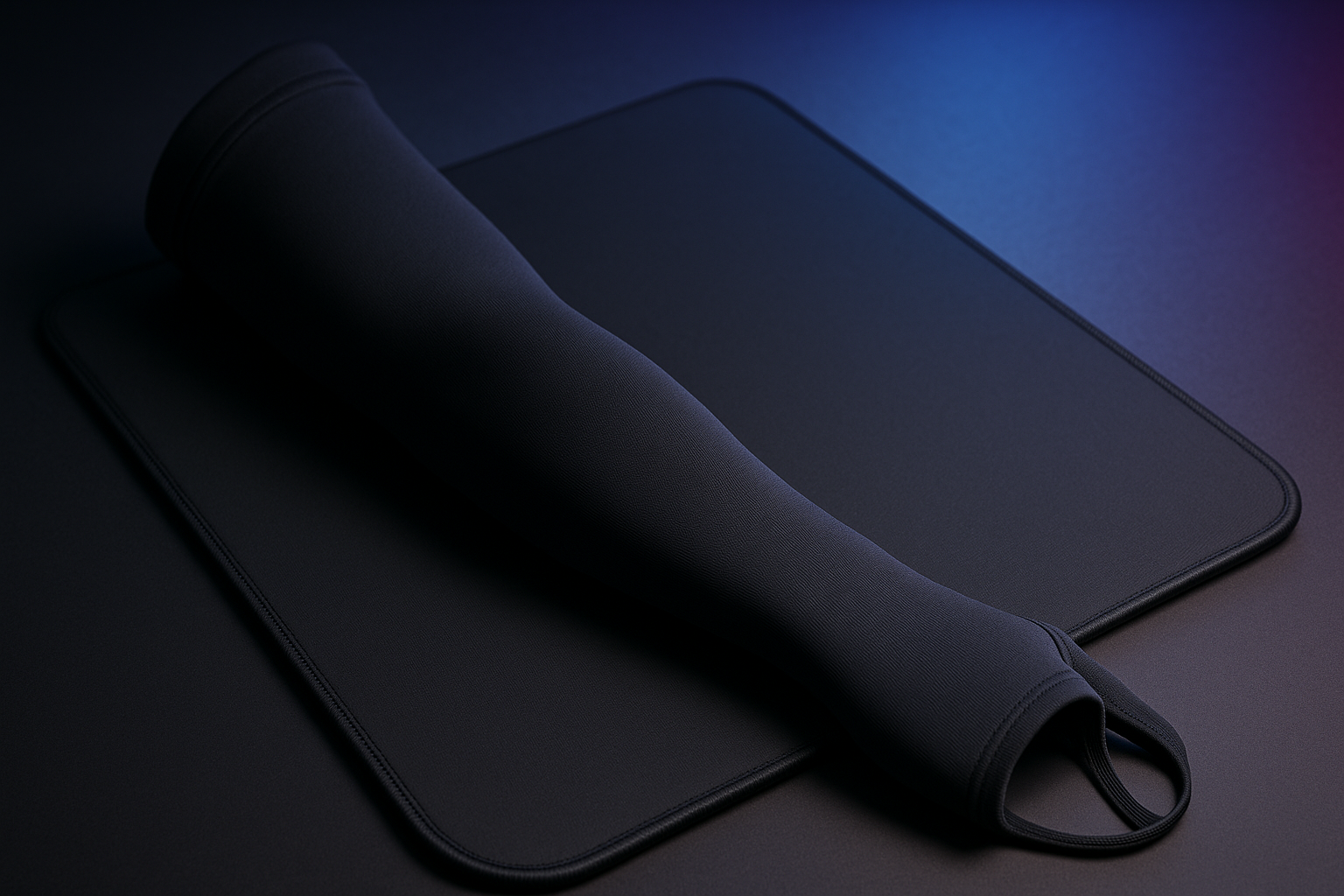
Product overview: Is this gaming arm sleeve worth considering in 2026?
Arm drag is a small problem until it ruins the same micro-adjustment for the fourth time. During a long FPS or TPS session, sweat can make bare skin cling to a cloth or glass mouse pad, while dry skin can catch unpredictably against the surface. A gaming arm sleeve tries to make that contact more consistent, but the Gear Fabric model is easier to assess as a concept than as an available purchase.
The product is listed as the Gear Fabric Specialized Double-Sided Arm Cover/Arm Sleeve/Gaming Only/Double Sided Usable/One Piece/Free Size/FPS/TPS/VALORANT/Apex /Rainbow6(Finger Hold S Size). It is described as a one-piece sleeve made for the part of your arm that repeatedly crosses the mouse pad while your hand controls the mouse. The stated design is double-sided and intended for direct mouse-pad contact.
The buying context is unusually clear: the listing shows a price of $0.00, yet the product is currently unavailable. That means you cannot treat the displayed figure as a deal, calculate a meaningful price-to-performance ratio from it, or assume that an order can be placed at no cost.
The supplied product data contains no rating, review count, verified-buyer comments, dimensions, supported circumference, or care instructions. So this review can examine the stated construction and intended use, but it cannot claim that buyers found the sleeve durable, comfortable, or accurate in practice. For a competitive player who wants to keep an existing cloth or glass pad, it may be worth watching—but only after stock and sizing are confirmed.

Key specifications and design at a glance
The confirmed specifications are compact, though the naming leaves one important question unanswered. Here is what the listing actually supplies:
| Specification | Listed detail |
|---|---|
| Material | 80% nylon, 20% spandex |
| Construction | One piece |
| Usability | Double-sided |
| Size description | Free size |
| Retention feature | Finger hold |
| Intended surfaces | Cloth and glass mouse pads |
| Listed game categories | FPS, TPS, VALORANT, Apex, and Rainbow Six |
Nylon generally contributes a smooth, hard-wearing textile surface, while spandex adds stretch and helps fabric follow movement. Those are reasonable material expectations, not proof of a particular glide speed or lifespan. The listing also uses “free size” and “Finger Hold S Size” in the same product name, which creates a genuine sizing ambiguity. Ask the seller to clarify what “S Size” refers to before purchasing.
The description claims low friction, breathability, sweat reduction, and smoother aiming. It does not provide a friction coefficient, fabric weight, sleeve length, measured circumference, or laboratory test. The product is a passive accessory: it changes the textile interface between your arm and pad, not your mouse sensitivity, polling rate, sensor, or in-game settings.
That distinction matters. The game references tell you who the product is aimed at, not what it can improve. A VALORANT player and an Apex player may both appreciate consistent arm movement, but neither should expect the sleeve to alter recoil control or compensate for unsuitable sensitivity.
Gear Fabric gaming arm sleeve features examined
The useful question is not whether the sleeve sounds competitive; it is whether it solves an irritating physical contact problem without introducing another one. Your forearm may cross the same section of pad hundreds of times during a session, and small changes in drag can become noticeable when the hand is making fine aiming corrections.
The low-friction claim applies to both cloth and glass surfaces. Covering the skin may reduce direct contact and make movement feel less sticky, particularly when perspiration changes the way your arm meets the pad. That could make sweeps feel more repeatable, but smoother movement is not the same as guaranteed accuracy or faster reactions.
Double-sided usability is practical in a modest, everyday way. You may be able to turn the sleeve over between washes or choose whichever side feels better against your particular pad. The listing does not say that the two sides use different weaves or textures, so you should not assume that one is faster and the other more controlled.
The claimed seamless construction may also help. Fewer raised seams can mean fewer pressure points as your forearm repeats the same path for several hours. Still, “seamless” does not guarantee zero irritation: the fabric edge, finger hold, tension, and your skin sensitivity will determine how unobtrusive it feels.
Buying takeaway: the strongest case for this gaming arm sleeve is comfort and contact consistency. The supplied information does not establish a measurable competitive advantage, so treat improved aim as a possible indirect benefit rather than the product’s proven outcome.
Aim control, arm drag, and mouse-pad compatibility
Arm drag can feel different depending on the surface beneath you. Woven cloth may create a familiar, slightly textured contact, coated fabric may feel more variable as moisture builds, and glass can make changes in skin contact especially obvious. During a tense match, a damp forearm may stick, release, and stick again instead of moving with one predictable level of resistance.
The Gear Fabric description specifically names cloth and glass mouse pads. That is a useful boundary: those are the surfaces you should evaluate, rather than assuming the sleeve has been tested on every desk mat, laminate surface, or hybrid pad. The sleeve could reduce skin-to-pad contact, but your mouse feet and the mouse-to-pad interface remain unchanged.
Less friction is not automatically better. Arm-heavy players using low sensitivity may welcome easier wide sweeps, while someone who relies on the arm for controlled stopping may find very low resistance less familiar. You need to judge whether movement becomes more predictable, not whether it simply becomes faster.
Use this comparison method before making a decision:
- Keep the same mouse, sensitivity, polling settings, and mouse pad.
- Run short tracking drills, wide flicks, and small micro-adjustments with your bare arm.
- Repeat the drills with the sleeve after allowing yourself time to adjust.
- Record comfort, unwanted sticking, stopping control, and repeatability rather than judging after one round.
No supplied benchmark proves a higher accuracy percentage, better tracking score, or quicker reaction time. The sensible description is a potentially useful comfort aid for consistent contact—not a performance guarantee.
Breathability, sweat management, and long-session comfort
The sleeve’s sweat-related promise is about reducing tackiness, not making perspiration disappear. By placing fabric between your skin and the mouse pad, it may prevent the particular sensation of a damp forearm catching on the surface during an intense match. That can matter when you play several hours and the same movement is repeated without a break.
The listed textile composition is 80% nylon and 20% spandex, and the description presents it as lightweight, stretchy, breathable, and skin-friendly. Those qualities are plausible for a thin stretch sleeve, but the product data includes no fabric weight, moisture-wicking test, drying time, or thermal rating. You should leave room for individual differences: a player in a cool room may find it comfortable, while another may notice heat quickly.
A barrier can limit skin contact while still absorbing sweat. If you use the sleeve for long sessions, regular washing becomes part of the experience even though no care instructions are supplied. Do not infer that double-sided construction makes the item hygienic indefinitely.
Seamless construction is relevant here because an edge or raised join can become more noticeable as the forearm crosses the same place repeatedly. Before a long session, wear the sleeve on clean, dry skin and keep a second clean sleeve or a towel nearby. Stop using it if you notice tightness, numbness, itching, or marks that persist after removal.
That routine sounds basic, but comfort accessories often fail through distraction rather than dramatic discomfort. If you keep adjusting the fabric instead of watching the angle of an opponent’s peek, the sleeve is not helping your setup.
Fit, finger hold, and movement considerations
The most unusual part of the listing is its sizing language. “Free Size” appears alongside “Finger Hold S Size,” and those descriptions do not tell you whether the sleeve is intended to stretch across a broad range or whether the finger-retention section is a smaller, specific size. You should not assume that free size means universally comfortable, and you should not assume that the finger hold will suit every hand.
The finger hold appears intended to anchor the sleeve while the arm moves, keeping the fabric from riding upward during repeated sweeps. The supplied description does not identify the specific finger, opening design, or adjustment method, so that purpose remains an inference from the name rather than a confirmed construction detail.
Fit can directly affect aim. Fabric that bunches at the wrist may create a new source of drag; fabric that is too tight may make you aware of pressure or restrict natural forearm movement. Exact sleeve dimensions, opening measurements, and supported circumference are missing, making fit the main unresolved purchase risk.
If the item returns to stock, use this check before ranked play:
- Confirm wrist and forearm measurements with the seller if they are not shown in the listing.
- Check that the finger hold lies flat and does not pull the sleeve sideways.
- Perform repeated left-right sweeps and notice whether the sleeve creeps, twists, or bunches.
- Run several minutes of low-sensitivity tracking before deciding whether the fit is usable.
A sleeve can be technically smooth and still be wrong for your arm. The best fit is the one you stop noticing after the first few minutes.

What Customers Are Saying
There is no customer evidence to summarize for this listing. The supplied product data includes no Amazon rating, review count, or individual comments, so it would be misleading to describe a buyer consensus or invent verified-buyer experiences. That limitation is more significant here than it would be for a simple, widely reviewed accessory because sizing and surface feel are highly personal.
If reviews become visible later, look for repeated observations about sleeve creep, finger-hold comfort, seam irritation, heat buildup, fabric pilling, and performance on both cloth and glass. A single complaint about sizing may reflect one unusual arm shape; several buyers reporting the same wrist opening or slippage during extended play would be much more useful evidence.
Read the newest comments first, then filter mentally for the reviewer’s setup. A casual player on a cloth pad may value softness differently from a low-sensitivity player using glass for broad arm movements. Session length matters too: a sleeve that feels fine for twenty minutes may become distracting after three hours.
Evidence limitation: the available details support an assessment of the stated design and materials only. They cannot confirm durability, wash performance, actual glide, finger-hold security, or real-world comfort. When customer reviews appear, weigh repeated patterns above isolated anecdotes and check whether buyers describe the same surface you use.
Who should consider this gaming arm sleeve?
This gaming arm sleeve is most relevant to an FPS or TPS player who aims with the forearm, notices bare skin sticking to the pad, and wants to keep an existing cloth or glass surface. If your problem is a sudden change in drag when your arm becomes sweaty, a fabric barrier is a reasonable thing to test before replacing the whole desk setup.
Players of VALORANT, Apex, Rainbow Six, and similar games may recognize the use case. Those games can involve repeated tracking, wide flicks, and tiny corrections, so an inconsistent contact surface may become one more distraction during a round. The sleeve will not improve fundamentals, but it might make the physical part of your setup feel less variable.
You may be a poor match if you need confirmed measurements before ordering, dislike any fabric between your arm and pad, strongly prefer a bare-arm feel, or require immediate delivery. The unavailable status alone makes this a difficult recommendation for a tournament starting soon.
Also keep the accessory in proportion. It does not replace cleaning the pad, choosing suitable sensitivity, or finding a mouse shape that fits your grip. Those decisions govern far more of your aiming setup than a sleeve does.
Decision rule: consider it only if reduced skin contact matters to you and you can verify both the size and current stock. If either point remains unclear, an available, measured alternative is easier to evaluate.
Comparison with alternative gaming arm sleeves
The most useful comparison is not which product has the more dramatic gaming language. It is which listing gives you enough information to predict fit, surface feel, and delivery. The Gear Fabric sleeve can be compared by name with the Skypad Gaming Arm Sleeve and the Aegend Arm Sleeves, but you should use the current listings to fill in the details rather than assuming that either alternative has a particular specification.
For each product, compare double-sided construction, material composition, finger retention, listed measurements, current price, rating, review count, and availability. The Gear Fabric listing clearly states its one-piece and double-sided design, but it does not supply the measurements or customer evidence needed to validate the practical experience.
Aegend Arm Sleeves may represent a broader category of sleeve rather than a product designed specifically around mouse-pad glide. Check whether the relevant listing emphasizes gaming contact, sun protection, compression, or general athletic use. A sleeve intended for sport may still work at a desk, but its priorities may not match yours.
The trade-off is straightforward. Gear Fabric’s stated textile composition and double-sided format may appeal to a player focused on glide and sweat-related contact. A competitor with clear measurements, active stock, and recent comments about mouse-pad use could be the safer choice even if its design sounds less specialized.
Use this comparison sequence: confirm the purpose, check sizing, compare material and seam design, read recent reviews, and then compare the delivered price. Do not compare a competitor’s purchasable total with Gear Fabric’s displayed $0.00, because the latter is not currently an obtainable offer.
Price, availability, and overall value assessment
The purchase reality comes first: the listing shows $0.00, but the Gear Fabric sleeve is currently unavailable. A zero-dollar display should not be described as a bargain, and it cannot be used to calculate normal value when no order can be completed at that figure.
If the item returns, the features you would be paying for are a double-sided contact surface, one-piece construction, the listed nylon-spandex textile, claimed low friction, and a barrier intended to reduce sweat-related stickiness. That combination is plausible for a comfort accessory, particularly if you already like your mouse pad and do not want to change it.
Value remains uncertain because the supplied details include no confirmed shipping cost, sale history, warranty information, customer evidence, durability estimate, or measurement chart. Even a modest price could be poor value if the sleeve slips, overheats, or does not fit your forearm.
When checking the listing during 2026, follow a simple process:
- Revisit the page and confirm that it still describes the same one-piece, double-sided version.
- Record the actual purchasable price and delivery cost, rather than the placeholder-style display.
- Verify that stock is available from the listing you are considering.
- Compare those details with at least one available alternative that supplies measurements and recent feedback.
The concept is reasonable for comfort-focused competitive players, but unavailable stock, ambiguous sizing, and absent customer evidence prevent a confident value recommendation today.
How to evaluate the sleeve before buying
Because the listing leaves several practical questions open, you should evaluate the item in a fixed order instead of being persuaded by the gaming claims alone. That approach takes a few minutes and can prevent the most common disappointment: receiving an accessory that feels distracting rather than helpful.
- Confirm the exact model. Check that the listing still describes the same double-sided, one-piece sleeve and that the displayed amount is a real purchasable price rather than a placeholder.
- Locate the fit information. Find or request exact wrist and forearm measurements, then compare them with your own while allowing enough stretch for comfortable movement.
- Clarify the finger hold. Ask which finger it is intended for and whether the retention feature works comfortably with your grip and normal arm movement.
- Read current feedback. Look for repeated comments about glide, slippage, heat, washing, and durability on the material of your own mouse pad.
- Test conservatively. Use familiar mouse settings in aim training or casual matches first. Only consider ranked play after the sleeve remains predictable through repeated sweeps and micro-adjustments.
The accessory should become unremarkable once you put it on. If you keep noticing the finger hold, correcting a twisted edge, or changing your movement to accommodate the fabric, it is not improving your setup—regardless of how promising the description sounds.
Pros and Cons
Pros
- One-piece, double-sided design is intended for repeated contact with a mouse pad.
- The listed 80% nylon and 20% spandex construction should provide a thin, stretchy textile interface.
- The design addresses two common annoyances for arm-aim players: skin drag and sweat-related stickiness.
- The sleeve is specifically described for cloth and glass mouse pads rather than only general athletic use.
- A finger-hold feature may help keep the sleeve positioned during repeated arm movements.
Cons
- Currently unavailable, so the displayed $0.00 price is not a purchasable offer.
- Sizing is unclear because “Free Size” appears alongside “Finger Hold S Size.”
- No rating, review count, customer comments, measurements, care guidance, or performance testing is supplied.
- The listing does not confirm whether the two usable sides have different textures.
- There is no evidence of improved accuracy, tracking percentage, reaction time, or competitive results.
Final Verdict
Key Takeaways
- The sleeve is designed to reduce skin-to-pad drag and sweat-related stickiness on cloth and glass mouse pads.
- Its confirmed design includes one-piece construction, double-sided usability, a finger hold, and an 80% nylon/20% spandex blend.
- The “Free Size” and “Finger Hold S Size” wording is ambiguous, and no measurements are supplied.
- The listed price is $0.00, but the item is currently unavailable and cannot be treated as a purchasable bargain.
- No ratings or customer comments are available, so real-world glide, durability, wash performance, and comfort remain unconfirmed.
Frequently Asked Questions
What size is the Gear Fabric gaming arm sleeve?
The product data lists a one-piece, double-sided sleeve described as free size, with a finger-hold design. However, the product name also includes “Finger Hold S Size,” and no wrist, forearm, opening, or length measurements are supplied. You should confirm the intended sizing with the seller before relying on the listing.
Does this gaming arm sleeve work on cloth and glass mouse pads?
The listing specifically describes use on both cloth and glass mouse pads. That indicates the intended contact surfaces, but no friction testing or glide benchmark is provided, so you should treat compatibility as a design claim rather than proof of improved aim.
Will the sleeve stop my arm from sticking to the mouse pad?
The sleeve is intended to reduce direct skin contact with the mouse pad and may limit sweat-related stickiness. It does not remove moisture, and the supplied details include no moisture-wicking test or thermal rating.
How much does the Gear Fabric sleeve cost?
The listed price is $0.00, but the item is currently unavailable. Because you cannot purchase it at that displayed amount, $0.00 should not be treated as a genuine obtainable deal or as a reliable basis for judging value.
Disclosure: As an Amazon Associate, I earn from qualifying purchases.