

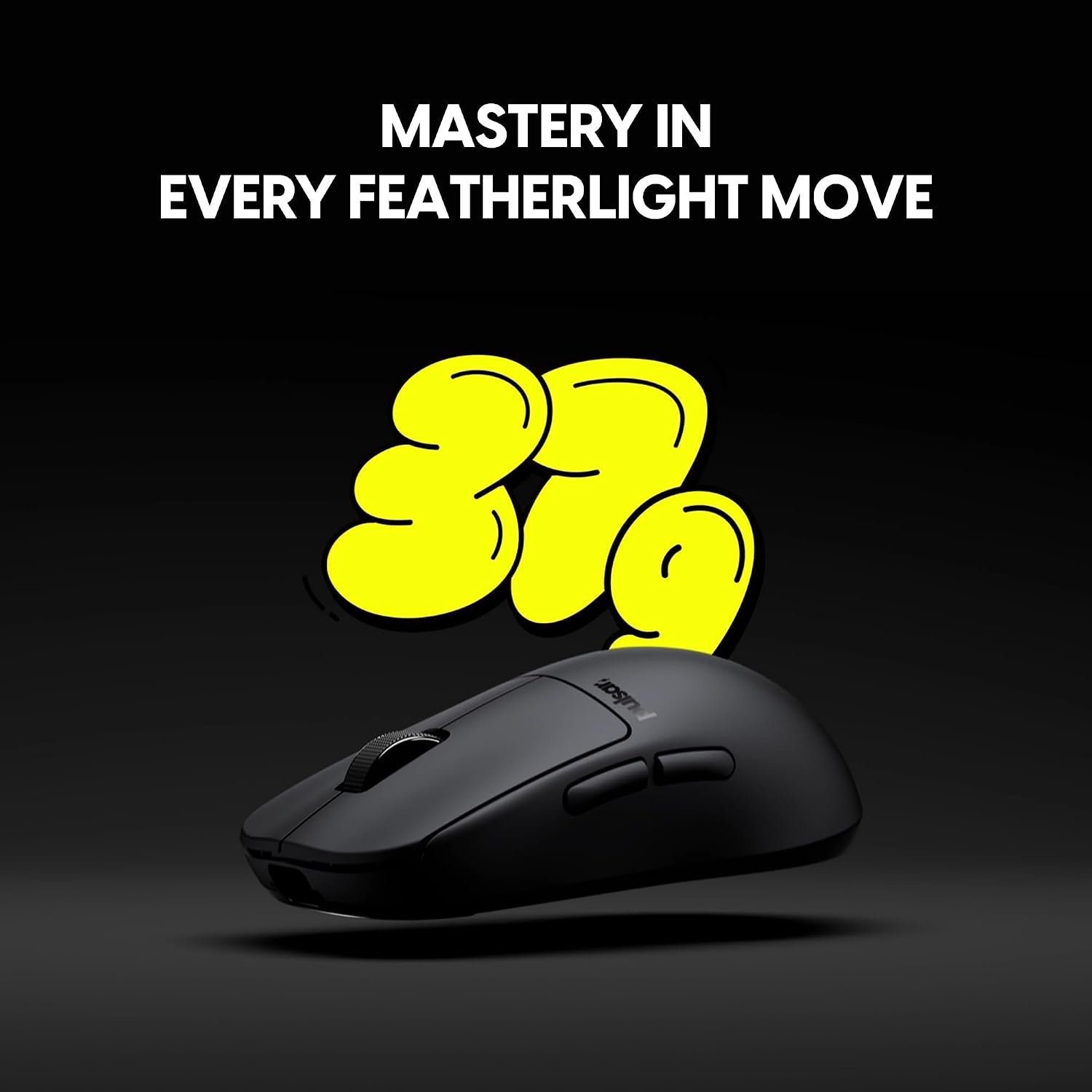
Pulsar Gaming Gears X2H Crazylight Wireless Gaming Mouse, Ultra Lightweight 1.30 oz (37g), Optical Switch, DPI, IPS, XS-1 Sensor, 8k Compatible (Jet Black) (Renewed)
A wireless gaming mouse weighing 37g sounds almost too light to deliver serious control, and the fact that this one is renewed makes the question sharper: are you getting a finely tuned competitive tool or a cheapened version of one? The Pulsar X2H Crazylight is a Jet Black renewed model listed at $86.40, down from an original price of $129.95, with only units shown as available at the time of the supplied listing.
The likely audience is fairly specific. If you play competitive FPS games, use low sensitivity, or hold your mouse in a claw or relaxed-claw grip, the combination of low mass and a broad symmetrical shell may be exactly what you want. If you prefer a substantial palm-filling body, extra controls, or the reassurance of a new product, the appeal is less obvious.
This review examines the documented sensor, optical switches, shape, skates, wireless claims, renewed-product value, and competing choices. The assessment reflects the product information available in 2026; confirmed specifications are kept separate from details that you should verify on the live listing before ordering.
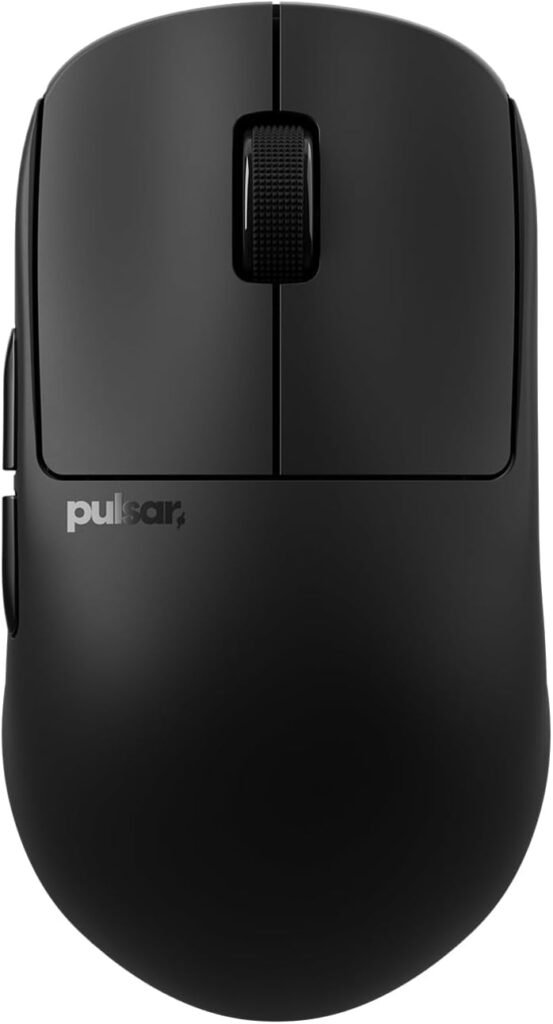

Pulsar X2H Crazylight at a glance
The Pulsar X2H Crazylight’s headline appeal is easy to identify, but headline numbers need interpretation. A 32,000 DPI ceiling gives you a wide configuration range; it does not mean you will aim better at that setting. Likewise, IPS and 50g acceleration describe how much movement the sensor is specified to accommodate, rather than guaranteeing superior accuracy in every game or on every surface.
| Specification | Listed detail | Practical meaning |
|---|---|---|
| Weight | 37g / 1.30 oz | Very low inertia for quick movement |
| Sensor | XS-1 optical sensor | Tracks movement optically |
| Resolution | 32,000 DPI | Broad sensitivity range |
| Tracking speed | 750 IPS | High stated movement ceiling |
| Acceleration | 50g | High stated acceleration tolerance |
| Switches | Optical | Designed to reduce unintended double-clicking |
| Encoder | Pulsar Blue Encoder | Tactile scroll-wheel rotation |
| Connection | Wireless; 8K compatible | Polling capability requires verification |
| Finish and condition | Jet Black; renewed | Prior use and cosmetic condition may vary |
The supplied information does not state battery capacity, battery-life rating, physical dimensions, included polling-rate hardware, warranty terms, or the cosmetic grade of the renewed unit. Treat 8K as a capability rather than proof that the package contains every receiver or accessory required to run at 8,000 Hz. Confirm those details before checkout.
Early assessment: this mouse is most compelling when low weight and claw-oriented ergonomics matter more to you than lighting, a heavy shell, or a long list of documented extras.
How the Pulsar X2H Crazylight’s 37g design changes everyday use
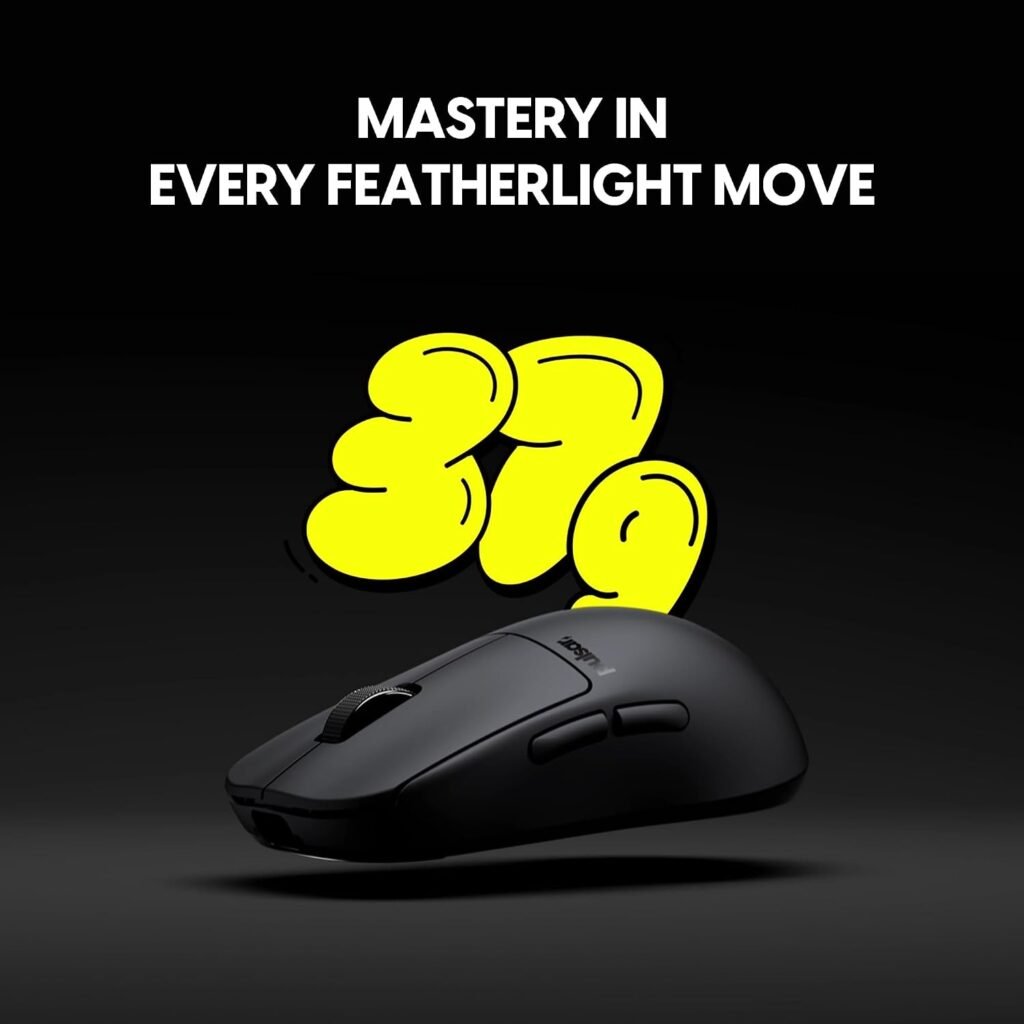
At 37g, the Pulsar X2H Crazylight is defined by what it lacks: inertia. A lighter body can feel easier to launch into a fast swipe and easier to redirect when you are tracking a target that changes direction. For low-sensitivity FPS play, where your hand may travel repeatedly across a large pad, that reduced effort can be noticeable by the end of a long session.
Weight is only half the experience, though. The low-profile, wide symmetrical shell is described as supporting claw and relaxed-claw grips. In practical terms, the rear hump and side contours should give your curled fingers something to brace against while leaving your palm less fully supported than it would be on a larger palm-oriented mouse.
That tradeoff will divide users. Some players want a planted object that resists accidental movement during office work, strategy games, or precise menu use. Others find heavier mice tiring or sluggish. Shape affects control more than a scale reading alone, because the rear contact point, side-button position, thumb placement, and ring-finger support determine whether your grip feels relaxed or clenched.
Use this fit test before buying:
- Compare the rear profile and overall width with your current mouse rather than relying on weight alone.
- Hold your usual claw or relaxed-claw position for several minutes.
- Check whether your thumb and ring finger remain supported without squeezing the shell.
- Make repeated direction changes and see whether the light body moves freely without feeling unstable.
Pulsar X2H Crazylight sensor performance: 32,000 DPI and IPS
The XS-1 sensor is specified at 32,000 DPI, with a stated tracking speed of 750 IPS and 50g acceleration. DPI describes sensitivity resolution; IPS describes the movement speed the sensor is rated to track; acceleration indicates the rapidity of movement it is designed to accommodate. These figures are useful technical ceilings, but most players will use only a small portion of them.
For ordinary competitive play, stable tracking at a sensitivity you can control is more valuable than selecting the highest available number. High IPS and acceleration are most relevant when you make a rapid flick, sweep across a large mousepad, or reverse direction quickly. They support that style of movement; they don’t guarantee better aim, steadier crosshair placement, or a higher rank.
Start with the sensitivity you already understand. Move slowly and quickly in an aim trainer or the practice range, then perform repeated horizontal swipes and abrupt reversals. Change one setting at a time only if the cursor or crosshair feels difficult to control. A comfortable grip and consistent motion should come before chasing a specification ceiling.
Before purchase, investigate the software and firmware controls. You want to know whether the configuration utility supports adjustable DPI steps, polling-rate selection, debounce controls, lift-off distance, and onboard storage. The supplied product information does not answer those questions, so don’t assume that every advertised capability is available in every connection mode.

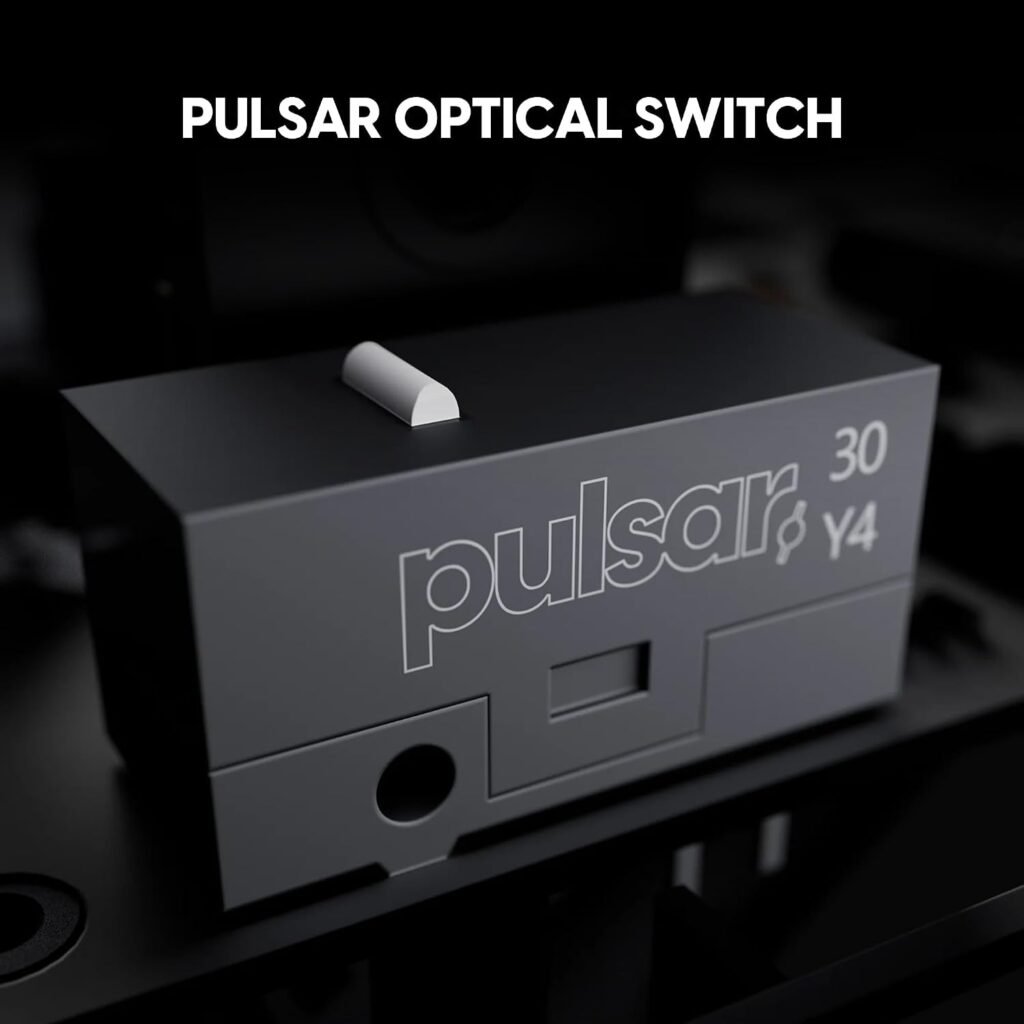
Optical switches, encoder, and click durability
The optical switches are intended to reduce the chance of unintended double-clicking while offering fast actuation for repeated shots and ability presses. That is a sensible design choice for a competitive mouse, but switch technology is not the same as a promise of infinite durability. Feel, sound, firmware behavior, and the condition of a renewed unit still matter.
The listed Pulsar Blue Encoder is the scroll-wheel component, described as providing tactile rotation. In a game, that may influence weapon selection and ability changes; outside a game, it affects menu navigation, document scrolling, and ordinary web use. A tactile wheel can feel reassuringly defined, although some users prefer a smoother or quieter rotation.
The product description also refers to a dust-proof structure. Read that as a construction claim that may help limit dust reaching internal components, not as waterproofing or protection from every long-term failure. Spills, impact, worn parts, and a previously used battery remain separate concerns.
Use the return window as a real test period. Perform left- and right-click checks, use both side buttons, click the wheel, and scroll repeatedly in a game and during ordinary desktop work. Listen for inconsistent clicks, test for accidental activations, and inspect the wheel for skipped or rough movement. With a renewed product, this check is part of the purchase decision rather than an optional extra.
Pulsar X2H Crazylight DOT skates and surface compatibility
The listing includes 16 Pulsar Dot Skates made from UHMW-PE, with each dot listed at 6.6mm. Small contact points can feel different from full-size feet: they may reduce friction and make the mouse easier to initiate, while also changing how much of the shell’s movement is stabilized by the pad.
The manufacturer describes these dots as suitable for glass and hard mousepads. That is helpful if you use a fast surface, but glide is never determined by the feet alone. Texture, dust, pad cleanliness, pressure from your hand, and your ability to stop accurately all affect the result. A faster glide can help broad tracking and large swipes; it can also feel less natural when you need a precise stop.
Judge the skates methodically rather than forming an opinion after one dusty session:
- Clean the mousepad and remove visible dust from the skate contact points.
- Test slow movements, rapid swipes, and controlled stops without pressing down on the shell.
- Compare the same movement on your normal surface and, if available, a second compatible hard surface.
- Inspect the skate edges for lifting or uneven contact after several sessions.
Because this is a renewed listing, check that the advertised skate set is actually included. It is also sensible to confirm that replacement dots are readily available before you commit to a setup that depends on them.
Pulsar X2H Crazylight wireless gaming performance and 8K compatibility
The confirmed wireless information is limited. The product is described as wireless and 8K compatible, but the supplied data does not specify its wireless technology, battery life, range, charging connector, or the receiver included in the package. Those omissions matter more in daily use than a maximum polling figure you may never select.
Polling at 8,000 Hz can provide more frequent cursor updates and may reduce the time between physical movement and reported movement. The benefit is more likely to matter with a high-refresh-rate display and a system capable of handling the extra update workload. On a basic display or an older computer, the difference may be difficult to see, while the processing cost can still exist.
Before ordering, verify four points:
- Whether an 8K receiver is included or must be purchased separately.
- Which software and firmware versions are required.
- Whether wired and wireless modes offer the same polling-rate choices.
- What battery-life expectation applies to the renewed unit.
Reliability should outrank the headline mode. A stable connection, predictable battery behavior, and consistent clicks are more useful than 8K polling that disconnects, drains quickly, or cannot be enabled with the included hardware. During the return period, test the mouse at your normal desk distance and display refresh rate, paying particular attention to wireless stability because prior use may affect a renewed unit.

What Customers Are Saying About the Pulsar X2H Crazylight
No verified star rating or review count was included in the supplied product data, so it would be misleading to invent a customer consensus or write “rated X/5.” The live listing should be checked immediately before publication, with the current rating, review count, and date checked stated plainly. That transparency is especially necessary when a renewed listing may combine experiences from different conditions.
When you read the customer record, look for repeated, specific comments about the things that will determine whether this mouse works for you:
- Praise for the 37g handling, claw-oriented shell, sensor responsiveness, click feel, glide, wireless stability, and build quality.
- Complaints about shell flex, side-button placement, wheel feel, battery life, receiver behavior, software, or missing accessories.
- Reports of inconsistent renewed condition, cosmetic wear, previous-use marks, packaging problems, or difficult returns.
Separate reviews of new units from reviews of renewed units whenever the listing allows it. A buyer describing a pristine new package is not answering the same question as a buyer who received a previously used mouse with uncertain battery health. Likewise, a complaint about side-button position may be a personal preference rather than a defect, while a missing receiver is an objective fulfillment problem.
Prioritize repeated reports over isolated remarks, then check whether recent comments refer to the currently listed Jet Black configuration. A careful review reader asks: is this a pattern, is it a defect, and does it apply to this condition label? That is more useful than simply counting enthusiastic or angry comments.
Who should buy the Pulsar X2H Crazylight?
The strongest match is a competitive FPS player who uses low sensitivity and wants minimal resistance during repeated large movements. Claw and relaxed-claw users are also the natural audience because the shell is designed around those positions rather than broad palm support. If your hand tends to hover over the mouse, the low mass may feel liberating; if your palm wants a substantial rear hump, it may feel incomplete.
The broad symmetrical form may suit players who shift between claw variations or dislike an aggressively right-handed contour. That does not make it universally ambidextrous or universally comfortable. Your thumb, ring finger, and rear contact point still determine whether the shape settles naturally.
It is less suitable if you want extensive lighting, numerous extra controls, or a large palm-oriented body. You should also be cautious if renewed electronics make you uneasy. The product can be pleasant for long desktop sessions because it is light, but the gaming-focused shape and the unspecified battery and warranty details prevent a blanket recommendation for every office.
Use this decision sequence:
- Identify whether you naturally use palm, claw, or relaxed claw.
- Compare the shell profile with your current mouse.
- Decide whether extremely low weight is a priority rather than a novelty.
- Verify the wireless and 8K requirements that matter to your setup.
- Read the renewed-condition, return, and warranty terms before paying.
Pulsar X2H Crazylight versus competing wireless gaming mice
The Logitech G Pro X Superlight is the more established lightweight wireless alternative for shoppers who value a familiar competitive shape, a mature software ecosystem, and greater confidence around support and warranty when buying new. Its design philosophy is still aimed at fast competitive play, but its fit may suit you better if you prefer a more conventional shape than the wide, claw-focused X2H shell.
The Razer Viper V3 Pro is another premium lightweight wireless option. It gives you a different symmetrical shape preference to consider, along with Razer’s high-end wireless and software ecosystem. The practical question is not which mouse advertises the largest DPI number. It is which body lets you hold the mouse consistently, which software controls you actually need, and whether you want the lower uncertainty of a new product.
Prices and stock for all three can change, so verify each live listing in $ before publication or purchase rather than relying on an old comparison. The fairest way to choose is by priority:
- Choose Pulsar if the 37g body and X2H claw-oriented shape are the central reasons you are shopping.
- Choose Logitech if familiar competitive handling and mature support matter more than pursuing the lightest possible body.
- Choose Razer if its shape and high-end wireless ecosystem fit your hand and setup better.
Shape compatibility should outrank specifications most players will never reach. A mouse that feels right at your normal sensitivity is more valuable than one with a higher maximum DPI.

Is the renewed $86.40 Pulsar X2H Crazylight good value in 2026?
At $86.40, the renewed Pulsar X2H Crazylight is listed against an original price of $129.95, an implied saving of $43.55. Only units were shown as available in the supplied listing, although stock can change quickly. The price is appealing because you are paying for a highly specialized package: a 37g body, XS-1 sensor, optical switches, tactile encoder, included dot skates, wireless operation, and stated 8K compatibility.
The saving has to be balanced against what is not documented. Battery health, prior use, cosmetic condition, accessory completeness, software support, and warranty or return coverage can materially change the value of a renewed mouse. A lower price is less impressive if you need to replace a receiver, discover worn skates, or return a unit because its battery no longer performs as expected.
Before ordering, work through this checklist:
- Confirm the seller and the exact renewed-condition label.
- Read the renewed warranty terms and identify who handles a fault.
- Check the return window and any condition requirements for a return.
- Verify that the 8K receiver, charging accessories, and advertised skate set are included.
- Save screenshots of the listed specifications and package contents.
The Pulsar Gaming Gears X2H Crazylight is a highly specialized lightweight wireless mouse whose value depends on grip fit, renewed condition, and confirmed accessory coverage. At $86.40, it is potentially attractive when you specifically want the X2H shape and 37g weight. If you mainly want a dependable wireless mouse and can find a comparable new model at a similar $ price, stronger warranty certainty may be worth more than the discount.
Pros and Cons
Pros
- Exceptionally light 37g design can reduce inertia during fast swipes and repeated direction changes.
- Wide symmetrical shell is intended for claw and relaxed-claw grips.
- XS-1 sensor is specified at 32,000 DPI, IPS tracking speed, and 50g acceleration.
- Optical switches are designed to reduce the likelihood of unintended double-clicking.
- Includes UHMW-PE Pulsar Dot Skates and states compatibility with glass and hard mousepads.
Cons
- Renewed condition leaves battery health, cosmetic wear, accessory completeness, and warranty coverage uncertain.
- The listing does not confirm battery capacity, battery-life rating, wireless range, charging connector, or whether an 8K receiver is included.
- The 37g shell and claw-focused shape may feel too insubstantial or restrictive for palm-grip users and those who prefer a heavier mouse.
Final Verdict
Key Takeaways
- The Pulsar X2H Crazylight is built around an unusually light 37g body, a wide symmetrical shell, and claw-oriented handling.
- Its XS-1 sensor is specified at 32,000 DPI, IPS, and 50g acceleration, but those maximums do not replace a comfortable sensitivity or good shape fit.
- Optical switches, the Pulsar Blue Encoder, and UHMW-PE dot skates give the design a serious competitive-gaming focus.
- The renewed listing is the central risk because battery health, cosmetic condition, included 8K hardware, and warranty coverage are not documented in the supplied information.
- At $86.40, it is potentially good value for a buyer who specifically wants the X2H shape and 37g weight; otherwise, a new competing mouse may offer greater certainty.
Frequently Asked Questions
Is the Pulsar X2H Crazylight renewed model worth considering?
The listed product is a renewed Jet Black wireless mouse priced at $86.40. Its documented headline specifications include a 37g weight, XS-1 Sensor, optical switches, wireless operation, and stated 8K compatibility. Battery health, cosmetic condition, warranty coverage, and included receiver details should be confirmed before purchase.
What grip is the Pulsar X2H Crazylight designed for?
The product description states that it supports claw and relaxed-claw grips through its low-profile, wide symmetrical shell. That does not guarantee a comfortable fit for every hand, so compare the shell profile with your current mouse and check whether your thumb and ring finger feel supported without squeezing.
Does the renewed mouse include everything needed for 8K polling?
The product is listed as 8K compatible, but the supplied information does not confirm that an 8K receiver is included or that every wireless mode operates at 8,000 Hz. Check the package contents, software requirements, and polling-rate options on the live listing.
Are the included dot skates suitable for glass mousepads?
The description lists Pulsar Dot Skates made from UHMW-PE, with each dot listed at 6.6mm. They are described as suitable for glass and hard mousepads, although actual glide depends on surface texture, cleanliness, pressure, and your preferred stopping control.
How much does the Pulsar X2H Crazylight cost?
The listed price is $86.40, compared with an original price of $129.95, implying a $43.55 difference. That can be attractive if you specifically want the 37g X2H shape, but the saving should be weighed against renewed-product uncertainty and the unknown condition of the battery and accessories.
Disclosure: As an Amazon Associate, I earn from qualifying purchases.